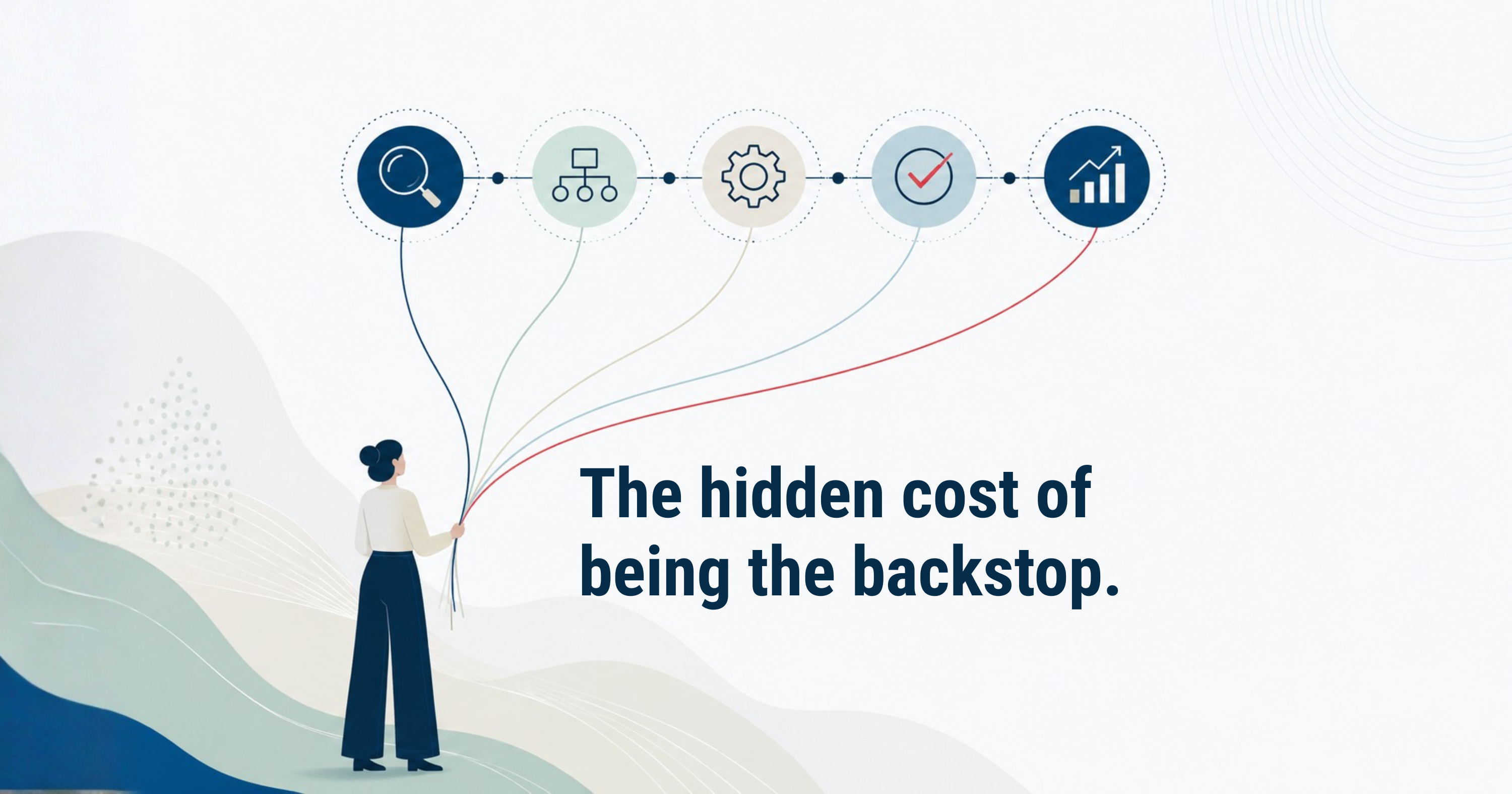
A COO delegates a recurring client performance report to a capable manager. The manager now “owns” the report, but every Thursday night the COO still checks the numbers, rewrites parts of the client narrative, and adds context from conversations the manager was not included in. The report goes out on time. The client is protected. No one sees a problem.
But the work has only partly been delegated. The task moved. The risk did not.
This is where many organizations create a hidden backstop: the person who is no longer officially responsible for the work, but remains the practical recovery plan if it fails. The backstop is the person people call when a handoff breaks, when the deadline slips, when the context is missing, or when the system cannot quite hold the work it has assigned elsewhere.
To be clear, every organization needs accountability. A CEO, founder, executive, or senior operator may appropriately remain the ultimate backstop for major risks. That is part of leadership. The problem is not that senior leaders carry accountability. The problem is when routine work repeatedly returns to the same person because the organization has not built ownership at the right level.
Leaders are often told to delegate more, trust their teams, and stop becoming the bottleneck. That advice is not wrong. But it is incomplete. Many delegation failures are not caused by a lack of trust. They happen because organizations assign work without transferring the capacity, clarity, authority, and recovery mechanisms required for real ownership.
When that happens, the task moves, but the risk stays with the backstop.
Not all delegation resistance is ego
It is easy to diagnose a leader’s reluctance to delegate as a personal issue. They are too controlling. Too perfectionistic. Too convinced that no one else can do the work as well as they can.
Sometimes that is true.
But sometimes what looks like control is actually pattern recognition. A leader has seen enough failed handoffs to know that assigning a task is not the same as transferring ownership. They know that if the work comes back incomplete, late, misaligned, or stalled, they will be the one fixing it under pressure. So they keep a parallel system. They check in more than they want to. They stay close enough to intervene because experience has taught them that the operating model cannot yet hold the delegation.
That does not make the behavior ideal. It does make it understandable.
It also does not mean every failed handoff is a system failure. Some people do not yet have the judgment, urgency, skill, or ownership maturity a role requires. A better operating model does not eliminate accountability. It makes accountability cleaner, because leaders can distinguish between someone who was unsupported and someone who was unwilling or unable to own the work.
The better question is not only, “Why won’t this leader let go?” It is also, “Has the organization created the conditions for anyone else to hold the work well?”
Assignment is not ownership
Many organizations confuse assignment with ownership.
Assignment answers the question, “Who is doing this?” Ownership answers a more demanding set of questions: Who has the context? Who can make decisions? Who manages tradeoffs? Who knows when to escalate? Who is accountable for the outcome, not just the activity?
This distinction matters because work can appear delegated in all the visible ways while still depending on the original leader in the ways that count. The task is on someone else’s list. Their name is in the project plan. The update says they own it. But if they do not have the authority to resolve blockers, the capacity to complete the work, or the context to make sound decisions, ownership has not really moved.
The organization has not delegated responsibility. It has distributed uncertainty.
That uncertainty is often absorbed by the backstop. They maintain the shadow tracker. They remain copied “just in case.” They remember the history no one documented. They know which stakeholder needs to be brought in before a decision is real. They are praised for being reliable, but rarely relieved of the load their reliability creates.
This is one of the reasons delegation can feel so frustrating for capable leaders. They are asked to let go, but punished by circumstance when the work returns to them in worse shape.
Reliable people are not an operating model
Many organizations confuse reliable people with reliable systems.
The work gets done, the client is protected, the deadline is met, and the issue is resolved, so the organization assumes the process is working. But sometimes the process is not working. Sometimes a reliable person is working around it.
Reliable people are invaluable. But they are not an operating model.
Reliability often starts with care. People care about the client, the team, the mission, the standard of work, or simply not letting others down. That care is one of the reasons organizations work at all. The problem comes when care becomes load-bearing.
A person can be capable and still lack context. They can be committed and still lack capacity. They can be trusted and still lack authority. They can be eager and still need a clearer definition of what “done” looks like.
In early-stage organizations, some of this is normal. Scrappiness is often necessary. People wear multiple hats, solve problems quickly, and move before the process is fully built. But scrappiness becomes dangerous when it stays invisible and permanent. What begins as flexibility can harden into an operating model no one chose, measured, or resourced.
Over time, the same people absorb the same gaps: the person who remembers the details, follows up after meetings, translates between teams, catches the dropped ball, and keeps things moving because they can see the consequences before others do.
At first, that person looks helpful. Eventually, they become infrastructure.
Capable people should not become the operating system
Every organization has people who make things work despite the system.
They know who needs to be consulted before a decision is real. They remember why a process changed three versions ago. They can anticipate which project will get stuck, which client will need reassurance, which vendor will require follow-up, and which internal handoff is more fragile than it appears in the meeting notes.
These people are often praised as indispensable. But “indispensable” can be a warning sign.
When capable people become the operating system, the organization may look functional from the outside while becoming increasingly fragile on the inside. Work gets done, but only because a few people are quietly absorbing ambiguity, correcting errors, and creating continuity that has not been designed into the business.
This is invisible labor, and organizations often reward it until they depend on it. The person who prevents the problem is less visible than the person who presents the win. The person who smooths the handoff is less visible than the person who owns the deliverable. The person who remembers the context is less visible than the person who makes the final decision. Over time, organizations can begin to reward the visible outcome while ignoring the hidden labor that made the outcome possible.
This pattern shows up in companies that are scaling faster than their systems. It shows up in founder-led businesses where decision-making still routes through one person. It shows up in mission-driven organizations where purpose makes people tolerate unsustainable conditions longer than they otherwise might. It shows up anywhere leaders confuse the ability to recover from weak systems with proof that the systems are working.
The company matters. The client matters. The team matters. The mission matters. But none of them should require the quiet collapse of the most capable people.
When helping becomes too hard
There is another cost leaders often miss: what happens to the person who wanted to help.
The same broken handoff can feel different depending on where someone sits. The leader may feel they are protecting the work, while the person receiving it may feel second-guessed, under-informed, or set up to miss invisible expectations.
A strong employee raises the same issue several times and eventually stops bringing it up. A manager tries to coordinate across teams without clear decision rights and becomes frustrated. A high performer agrees to take on a project, then realizes the priorities keep changing and the real decision-maker is never available. Most people do not disengage all at once. They disengage slowly, often after trying for longer than anyone noticed.
At first, they try harder. They chase context. They ask questions. They fill gaps. They make assumptions. They absorb friction because they care about the work.
Then something shifts.
In paid work, that shift may look like cynicism, bare-minimum performance, quiet job searching, or being labeled “negative.” But leaders should be careful not to confuse sustainable boundaries with disengagement. Sometimes the person who stops absorbing every gap is not becoming less committed; they are becoming more honest about the limits of an operating model that depended on their overextension.
In volunteer or mission-driven work, the same pattern may look like people fading away, becoming reactive, or taking operational problems personally because the mission itself feels personal.
A person who has become hard to work with may have started as the person trying hardest to help. Systems can turn care into resentment.
That does not excuse poor behavior. But it should make leaders curious. Before deciding someone stopped caring, it is worth asking how long they were trying to care inside a system that made caring too costly.
Real delegation is a two-way agreement
Better delegation does not start with letting go. It starts with making sure the work has somewhere real to land.
Real delegation requires capacity, clarity, authority, and recovery. The person receiving the work needs the time and bandwidth to take it on, a clear understanding of the outcome and what “done” looks like, enough decision-making authority to move the work forward, and a shared understanding of when to escalate or what happens if they get stuck. These questions may sound basic. In practice, they are often skipped, especially in organizations that are moving quickly or pride themselves on being scrappy.
But ownership is not only given. It is also accepted. The person receiving the work has responsibilities too: to surface ambiguity, confirm expectations, name capacity constraints, ask for missing context, and escalate risk early. Real delegation works when the leader creates the conditions for ownership and the person receiving the work actively participates in holding it.
That balance matters. Otherwise, “the system was unclear” can become an excuse for poor communication, just as “they should have owned it” can become an excuse for poor leadership.
Clarity is not bureaucracy. It is a form of care. It protects the person doing the work, the leader delegating it, and the organization depending on the outcome. It also protects accountability, because people can be held responsible for work they were actually equipped and empowered to own.
Start with one repeated rescue
For leaders already operating at capacity, this can sound like one more thing to do. That’s part of the trap. The person most aware of the broken handoff is often the person with the least available room to fix them, because they are busy absorbing the consequences.
The answer is not to redesign the whole organization at once. Start with one repeated rescue. Choose the rescue loop that is most frequent, most costly, most risky, or most dependent on one person’s memory. Where does work most often return to you? What are you privately tracking because you do not trust the system to hold it? What do people keep asking you that they should not need you to answer?
You do not need authority over the whole organization to begin. You can start with the rescue loop closest to your own team, project, or recurring decision.
If the repeated rescue is the client report, the first repair may not be a new reporting system. It may be clarifying the report’s purpose, decision rights, source data, review point, and escalation path before Thursday night.
The goal is not perfection. The goal is to turn one invisible dependency into an intentional structure.
Rescue solves the immediate problem. Repair changes the pattern.
Delegation without capacity, clarity, authority, and recovery is not leadership. It’s risk transfer.
If the same person is always the recovery plan, the problem is not that they need another reminder to let go. The problem is that the organization has not built a system that lets responsibility move safely.
That is the real work: not simply telling leaders to delegate more, but building operating models strong enough that they can.
If this feels familiar, it may be worth looking at where the work keeps coming back.
Stableford Solutions helps founders, operators, and leadership teams build the operating clarity that makes responsibility easier to hold, share, and sustain.